Blinn College nursing students recognized at national conference
Students Eva Milnes and Irma Sosa received awards at the Organization for Associate Degree Nursing Annual Convention
February 19, 2026
Two Blinn College District associate degree nursing (ADN) students recently were recognized for their innovative research at the Organization for Associate Degree Nursing’s (OADN) Annual Conference.
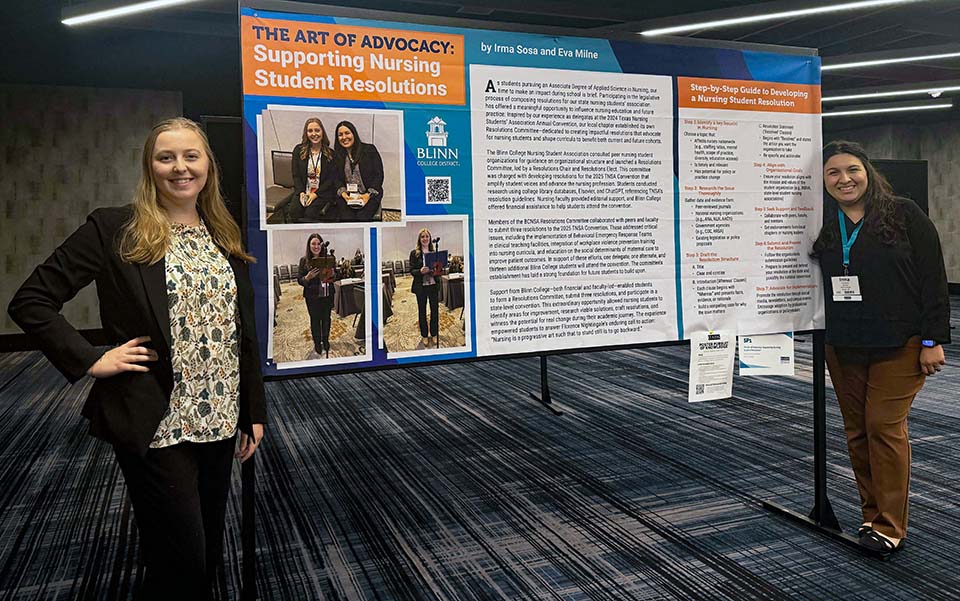
December graduate Eva Milne’s poster “Impact to Exposure to Health Professional Shortage Areas on ADN Student Career Choices” was awarded second place and Milne’s joint poster with student Irma Sosa “The Art of Advocacy: Supporting Nursing Student Resolutions” was awarded third place at the convention.
“I couldn’t have imagined a better way to begin my nursing career than going to a national convention and being recognized for my work,” Milne said. “Being in the same room with nursing leaders, academics, and innovators showed me what was possible for my own nursing career.”
Milne’s solo paper examined the challenges of getting more nursing students interested in choosing careers located in areas severely lacking nursing professionals. As a result of her research, Milne was surprised to learn that Brazos County, where Blinn ADN students complete their clinical rotations, is a health professional shortage area (HPSA).
“Most of my fellow students also didn’t realize we are already in an HPSA,” Milne said. “Presenting this advocacy poster was a great way to showcase our ability to impact nursing professionals even as students.”
Milne is pursuing her passion for women’s health care by working in the labor and delivery department of St. Joseph Health Regional Hospital. A member of the Alpha Delta Nu Nursing Honor Society, Milne also received her class’s Leadership Award.
Milne and Sosa’s joint research highlighted the process of submitting Blinn’s first student-led resolutions to the Texas Nursing Students’ Association (TNSA). Milne and Sosa each submitted successful resolutions. Their OADN poster showcased how to navigate the resolution process, which can serve as a framework for future students. Milne and Sosa both credit Blinn’s ADN Program faculty with being instrumental in their success.
“We couldn’t have done this without the support of our nursing faculty, who encouraged us every step of the way. Presenting our resolutions at the state level was incredibly inspiring and I grew so much as a nursing student,” Sosa said. “Blinn has created an environment where students can truly thrive, and the opportunities I have had for advocacy have deepened my passion for nursing and strengthened my confidence as I prepare to enter this profession.”
Sosa will pursue intensive care unit nursing after graduating from Blinn’s program in spring 2026 with plans to obtain her doctorate.
Based at the RELLIS Academic Alliance Complex at Texas A&M-RELLIS in Bryan, Blinn’s ADN Program is a two-year course of study that prepares students to serve as registered nurses. In addition to the program’s 512-hour clinical rotation requirement, students complete traditional lecture-style courses, labs, and gain hands-on skills utilizing the campus’s 16,000-square-foot simulation laboratories. Most students dedicate 15 to 24 hours each week to scheduled program activities and at least 30 hours per week on study and preparation.
Students who complete Blinn’s ADN Program and pass the National Council Licensure Examination (NCLEX) have a job placement rate between 97 and 100% and are qualified for a wide array of nursing positions. With demand soaring in the nursing field, the U.S. Bureau of Labor Statistics reports that registered nurses earn a median salary of $93,600.
“I couldn’t be happier with my nursing education,” Milne said. “The classroom and my clinical rotations have made me confident to embark on my nursing career, but I feel so lucky to have been part of a program that invests in their students and supports their research. I attended two TNSA conventions as well as Nurses’ Day at the Capitol in Austin, where I saw how nurses are shaping legislation.”
Sosa echoes this sentiment.
“I strongly encourage nursing students to get involved beyond the classroom. These experiences enrich your education, build confidence, and open doors you never expected,” Sosa said.
Blinn’s ADN Program offers multiple pathways, including a traditional two-year track and transition options for licensed vocational nurses and paramedics. Blinn also maintains co-enrollment partnerships with several universities, providing students with streamlined pathways to their Bachelor of Science in Nursing (BSN). The Aggie Student-Centered Express Nursing Degree (ASCEND) Program allows Blinn students to complete their BSN from the Texas A&M University College of Nursing at an accelerated timeframe after earning their associate degree.
The application cycle for fall 2026 admission into all three tracks of Blinn’s ADN Program is open until March 6. For more information, visit www.blinn.edu/adn.
Enjoy this article? Share it with one click!